On this page
- Why isn’t total testosterone enough?
- What does each biomarker tell you?
- When should men get their hormones tested?
- What time of day should I test?
- Can I test these at home?
- What happens if my levels are off?
- How often should I retest?
- What’s a “normal” testosterone level?
- Do I need a doctor’s order to test?
- Key takeaways
A useful male hormone panel goes beyond total testosterone. Key markers include free testosterone, total testosterone, luteinizing hormone (LH), sex hormone binding globulin (SHBG), estradiol and prostate-specific antigen (PSA). Together they show how much testosterone you make, how much your body can use, why levels may be low, and whether anything needs a closer look before treatment.
Why isn’t total testosterone enough?
Total testosterone measures all the testosterone in your blood, but much of it is bound to proteins and not readily available to your tissues. Two men with the same total testosterone can feel very different depending on their free testosterone and SHBG. Testing only one number can miss the cause of your symptoms.
What does each biomarker tell you?
Total testosterone
Your overall testosterone level, a starting point for assessing hormone health.
Free testosterone
The portion that isn’t bound to proteins and is readily available for your body to use. It can be low even when total testosterone looks normal.
Luteinizing hormone (LH)
The signal from your brain that tells your testes to produce testosterone. LH helps show why testosterone might be low, whether the signal is weak or the testes aren’t responding, which shapes treatment options. Learn more about LH.
Sex hormone binding globulin (SHBG)
A protein that binds testosterone. High SHBG can leave less free testosterone available. See SHBG: what you need to know.
Estradiol
The main form of estrogen. Men need some, but the balance with testosterone matters for mood, libido and body composition. Read understanding estradiol levels in men.
Prostate-specific antigen (PSA)
A marker of prostate health. It’s an important safety check for men considering hormone treatment.
When should men get their hormones tested?
Consider testing if you notice ongoing low energy, low motivation, poor sleep, weight gain, slower recovery or low libido, or if you’re trying to conceive. Testing before starting any hormone treatment gives you and your clinician a baseline to compare against. These symptoms can have many causes, so review your results with a clinician.
What time of day should I test?
Morning. Testosterone typically peaks early in the day, so testing first thing gives the most consistent results. Avoid vigorous exercise beforehand and stay hydrated. Fasting usually isn’t needed for a hormone panel like the Vitality Test.
Can I test these at home?
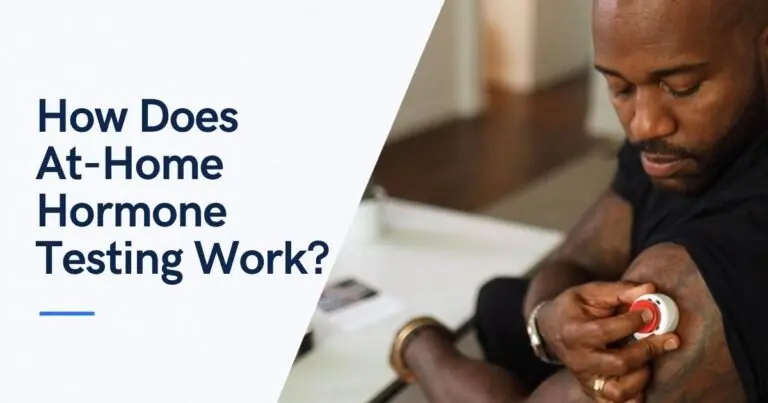
Yes. The Vitality Test™ measures all six of these markers from a small blood sample you collect at home with a nearly painless, FDA-cleared upper-arm device. A CLIA-certified lab analyzes it, and results plus a telemed consult link arrive within 5–7 business days after the lab receives your sample. Here’s how at-home hormone testing works.
What happens if my levels are off?
Your included telemed consult covers what your numbers mean in the context of your symptoms and history. If appropriate, a clinician from our partner medical practice may recommend the Reboot Program™, which is designed to support your body’s own production rather than replace it. The program is optional, and there’s no further obligation after your consult. Other men may simply benefit from lifestyle changes or nutritional support like our Vitality Packs.
How often should I retest?
If you start a treatment program, periodic follow-up testing lets your clinician track progress and adjust your plan. If you’re not on treatment, ask your clinician how often retesting makes sense for you.
What’s a “normal” testosterone level?
Lab reference ranges are wide and differ between labs, and a number inside the range doesn’t always mean you feel your best. That’s why clinicians look at your full panel together with your symptoms rather than one number in isolation. Your consult is the place to ask what your specific results mean for you.
Do I need a doctor’s order to test?
With the Vitality Test, you order the kit directly, and the consult to review your results is included, so you don’t need to schedule a separate appointment first.
Key takeaways
- Test more than total testosterone: free T, LH, SHBG, estradiol and PSA all add context.
- LH helps explain why testosterone is low, which guides treatment choices.
- Test in the morning, hydrated, without vigorous exercise beforehand.
- You can test all six markers at home with the Vitality Test.
- Always review results with a clinician.
Ready to know your numbers? Order the Vitality Test™ — an at-home hormone test kit that includes a telemedicine consult to review your results.

Dr. Garrett Wdowin
Dr. Garrett Wdowin is a naturopathic medical doctor specializing in anti-aging and regenerative medicine, and the founder of Wdowin NMD in Corona Del Mar, California. He earned his undergraduate degree at Brown University and his Doctor of Naturopathic Medicine at Southwest College of Naturopathic Medicine, and in 2012 completed a fellowship in anti-aging and regenerative medicine from the American Academy of Anti-Aging Medicine (A4M).